

Did you know that charging a Mitsubishi Outlander PHEV during off-peak hours in Connecticut can cut your per-mile driving costs by more than 50% compared to using gasoline? With regular gas prices often reaching $3.88 across Fairfield County, it's no wonder drivers in Brookfield and Danbury are looking for relief. You've likely felt the sting of high Eversource or UI delivery charges, making you question if calculating fuel savings with a PHEV CT is even worth the effort.
We agree that the math can feel overwhelming, especially when you factor in how our freezing New England winters impact battery efficiency. This guide provides the exact formula you need to determine your monthly savings. We'll explore how to leverage off-peak charging rates and explain why the 45-mile all-electric range of the 2026 Mitsubishi Outlander PHEV is a game-changer for the average Connecticut commute.
Key Takeaways
- Master a simple step-by-step formula for calculating fuel savings with a PHEV CT to see exactly how much you can trim from your monthly budget.
- Learn how to navigate the complex delivery charges from Eversource and UI to find your true price per mile on electricity versus gasoline.
- Discover why the 45-mile all-electric range of the Mitsubishi Outlander PHEV is perfectly sized to cover the average round-trip commute in Connecticut.
- Find out how to use specialized driving modes to optimize your energy consumption while navigating heavy traffic on I-84 or Route 7.
How to Calculate Your Monthly PHEV Fuel Savings
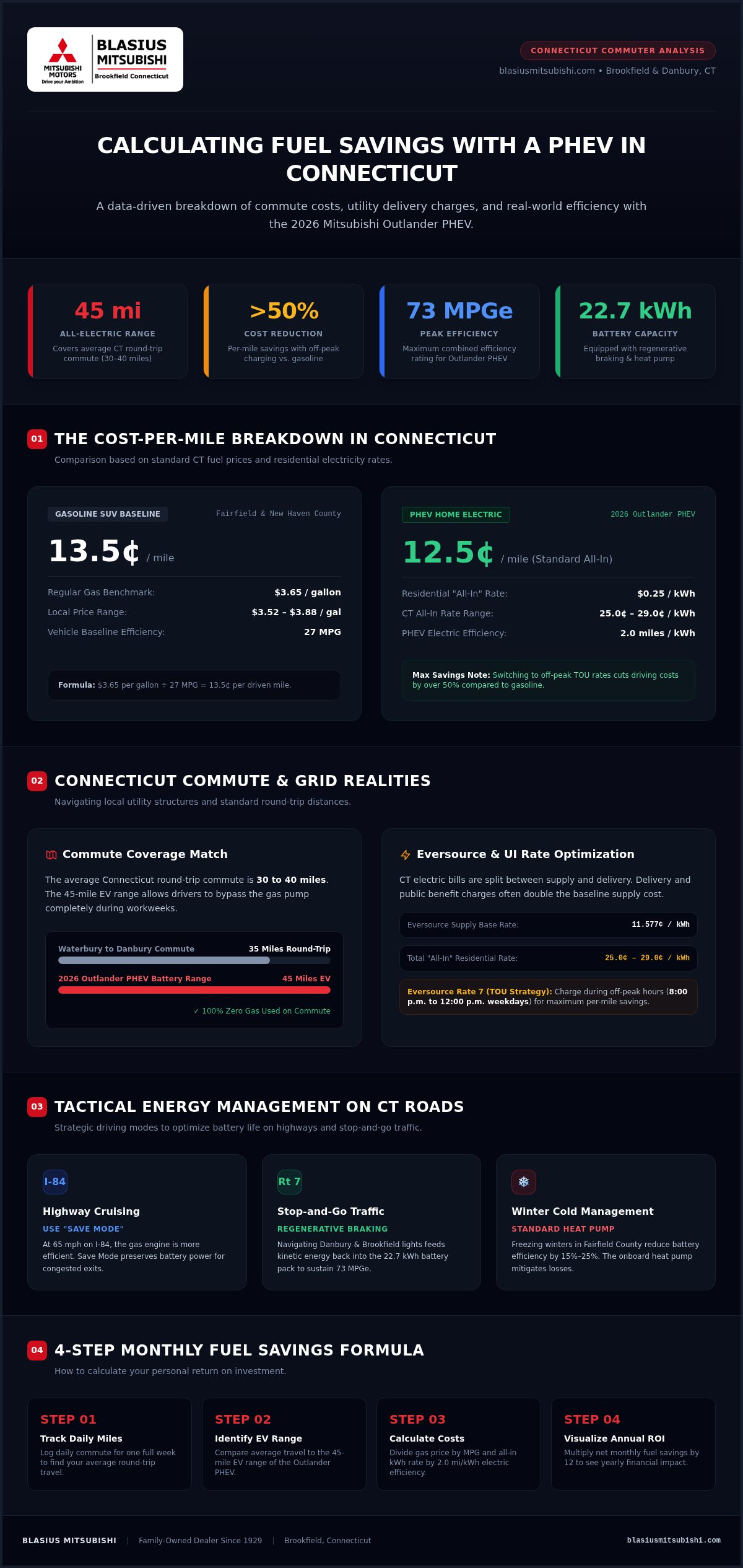
Understanding the financial impact of switching to plug-in hybrid electric vehicles requires looking past the window sticker. To begin calculating fuel savings with a PHEV CT, you'll need to track your daily mileage against your vehicle's battery-only range. If your round-trip commute from Waterbury to Danbury is 35 miles, a vehicle with a 45-mile electric range essentially eliminates your daily gas consumption. You can track this by resetting your trip odometer each morning and noting when the internal combustion engine engages.
The Formula: Gas vs. Electric Miles
Your monthly cost-per-mile is determined by dividing your local fuel price by your MPG or your utility's all-in kilowatt-hour (kWh) rate by your vehicle's electric efficiency. Subtract your "Electric-Only" miles from your total monthly travel to find your remaining gas dependency. For precise technical specifications on battery capacity and efficiency, consult our 2026 Mitsubishi Outlander PHEV Guide.
Finding your price per mile involves checking your Eversource or UI bill for the "all-in" rate, which includes delivery and public benefit charges. In Connecticut, regular gasoline at $3.65 per gallon and a 27 MPG efficiency results in roughly 13.5 cents per mile. Contrast this with home charging: at an all-in rate of $0.25 per kWh and an efficiency of 2.0 miles per kWh, your cost drops to 12.5 cents. While the gap seems small on paper, the savings multiply when you leverage off-peak charging or home solar panels.
- Track Miles: Log your daily commute for one full week to find your average.
- Identify Range: Compare this average to the 45-mile EV range of the Outlander PHEV.
- Visualize ROI: Multiply your monthly savings by 12 to see the annual impact compared to a traditional gas-only SUV.
Factoring in Connecticut Variables: Electricity vs. Gas
Local gas prices in Danbury and Waterbury often fluctuate between $3.52 and $3.88 per gallon, making the decision to switch to a plug-in hybrid a tactical financial move. While national tools like the DOE Vehicle Cost Calculator provide a helpful baseline, they often miss the specific nuances of our state's energy grid. When calculating fuel savings with a PHEV CT, you must account for the high delivery fees that drive our all-in residential electricity costs to between 25.0 and 29.0 cents per kilowatt-hour.
Understanding CT Utility Rates and Off-Peak Savings
Your electric bill is split into "Supply" and "Delivery" charges. While the supply rate for Eversource is currently 11.577 cents per kWh, the delivery portion often doubles that amount. To maximize your ROI, switch to a Time-of-Use (TOU) rate like Eversource Rate 7. This allows you to charge your Mitsubishi Outlander PHEV during off-peak hours (8:00 p.m. to 12:00 p.m. weekdays) when supply costs are significantly lower. Keeping your battery and drivetrain in peak condition at a Mitsubishi service center in Brookfield, CT ensures you maintain this efficiency year-round.
Don't forget the impact of Connecticut’s seasonal temperature swings. Sub-freezing winters in Fairfield County can reduce real-world battery efficiency by 15% to 25%. However, even with this drop, the Outlander PHEV’s standard cold-weather heat pump helps mitigate losses. By focusing on off-peak charging and maintaining your vehicle, you can protect your long-term ROI regardless of the weather. If you're ready to see how these numbers fit your budget, you can browse our new Mitsubishi inventory today.
Maximizing ROI with the Mitsubishi Outlander PHEV
The 2026 Mitsubishi Outlander PHEV offers a 45-mile all-electric range, which perfectly aligns with the average Connecticut round-trip commute of 30 to 40 miles. When you are calculating fuel savings with a PHEV CT, this range means most local drivers can bypass the gas pump entirely during the work week. According to the U.S. EIA Connecticut State Profile and Energy Estimates, our state faces some of the highest energy costs in the nation, making it vital to use the vehicle's "Save Mode" or "Charge Mode" strategically. On high-speed stretches of I-84, switching to Save Mode preserves your battery for the stop-and-go traffic you'll inevitably hit in Danbury or Norwalk. This tactical approach ensures you aren't wasting battery power at 65 mph, where the gas engine is more efficient for the load.
Real-World Efficiency for Brookfield and Danbury Drivers
Navigating Route 7 requires a vehicle that handles constant braking and acceleration without draining your wallet. The Outlander PHEV excels here, utilizing regenerative braking to feed energy back into its 22.7 kWh battery pack. To keep these systems performing at their 73 MPGe peak, regular maintenance is essential. As a family-owned dealer since 1929, Blasius Mitsubishi provides the specialized care needed to protect your battery health and long-term ROI. If you're comparing trims to see which fits your Fairfield County lifestyle, explore our Mitsubishi Outlander for Sale in Connecticut guide. Professional service at our Brookfield center ensures your vehicle stays efficient, helping you maintain those monthly fuel savings for years to come.
Start Your Path to Lower Monthly Costs
Switching to a plug-in hybrid is about more than just reducing emissions; it's a strategic move for your wallet. By understanding your utility's off-peak rates and leveraging the 45-mile all-electric range of the Outlander PHEV, you can master calculating fuel savings with a PHEV CT for your specific commute. Whether you're driving through Waterbury or Danbury, the right charging habits and driving modes will keep your costs low even as energy prices fluctuate.
At Blasius Mitsubishi, we've been family-owned and operated since 1929. Our on-site certified Mitsubishi technicians are here to help Fairfield and New Haven County drivers maintain their vehicle's peak efficiency for years to come. Ready to see the numbers in action? Browse our new Mitsubishi Outlander PHEV inventory in Brookfield today. We're excited to help you find the perfect match for your budget and lifestyle.
Frequently Asked Questions
How much can I realistically save on gas with a PHEV in Connecticut?
Drivers in Danbury and Brookfield can save hundreds of dollars annually by maximizing the 45-mile all-electric range of the 2026 Mitsubishi Outlander PHEV. If your daily commute stays within this limit, you'll rarely visit the gas pump for routine travel. When you're calculating fuel savings with a PHEV CT, remember that consistent home charging can cut your monthly gasoline expenditures by more than half compared to a traditional SUV.
Are electricity rates in CT too high to make a plug-in hybrid worth it?
While Connecticut has high all-in electricity rates, plug-in hybrids remain cost-effective when you use strategic charging. By switching to a Time-of-Use rate through Eversource or UI, you can charge overnight for significantly less than the cost of gasoline. Even at standard residential rates, the high efficiency of the Outlander PHEV powertrain often results in a lower cost-per-mile than paying for regular fuel at local stations.
Do I need a Level 2 charger at home to see fuel savings?
You don't need a Level 2 charger to begin saving, as the Outlander PHEV can charge overnight using a standard 120V household outlet. This Level 1 charging is sufficient to replenish the battery for a typical commute in the New Haven or Waterbury areas. However, installing a Level 2 charger allows for faster top-offs between errands, which helps you stay in electric mode more often throughout the day.
How does CT winter weather affect my PHEV fuel savings calculations?
Sub-freezing temperatures in Fairfield County can reduce battery efficiency by 15% to 25% during the coldest months. Your calculations should account for the internal combustion engine engaging more frequently to provide cabin heat. To protect your ROI, the Outlander PHEV features a cold-weather heat pump and thermal management system. This helps maintain better range during a Connecticut winter than many vehicles without these specialized systems.


