

What if you could drive from Brookfield to Stamford in the middle of a January cold snap without your gas engine ever kicking in? It's a common concern for Connecticut drivers who watch their dashboard estimates shrink as soon as the frost hits the windshield. You've likely felt that familiar anxiety when the temperature drops, wondering if your plug-in hybrid will lose its edge in the snow. However, winter doesn't have to mean sacrificing your electric commute. We'll show you how the 2026 Mitsubishi Outlander PHEV uses its 22.7 kWh battery and upgraded heating systems to preserve your 45-mile range potential even when the weather turns. This guide explores specific ways to optimize your Mitsubishi Outlander PHEV range winter performance through smart pre-conditioning and S-AWC settings. You'll learn how to keep your vehicle in EV mode longer and why local experts recommend winter battery health checks.
Key Takeaways
- Learn why freezing temperatures impact battery chemistry and how to manage the heating penalty to protect your Mitsubishi Outlander PHEV range winter performance.
- Discover how to use the Mitsubishi Connect app for cabin pre-conditioning while plugged in so you don't waste battery power on initial heating.
- Master energy-saving habits like prioritizing heated seats and steering wheels to reduce the load on the climate control system and extend your EV driving distance.
- Understand how Super All-Wheel Control and Snow Mode provide instantaneous traction on icy Connecticut hills while maintaining maximum efficiency.
The Science of Cold: Why the Outlander PHEV Range Changes in Winter
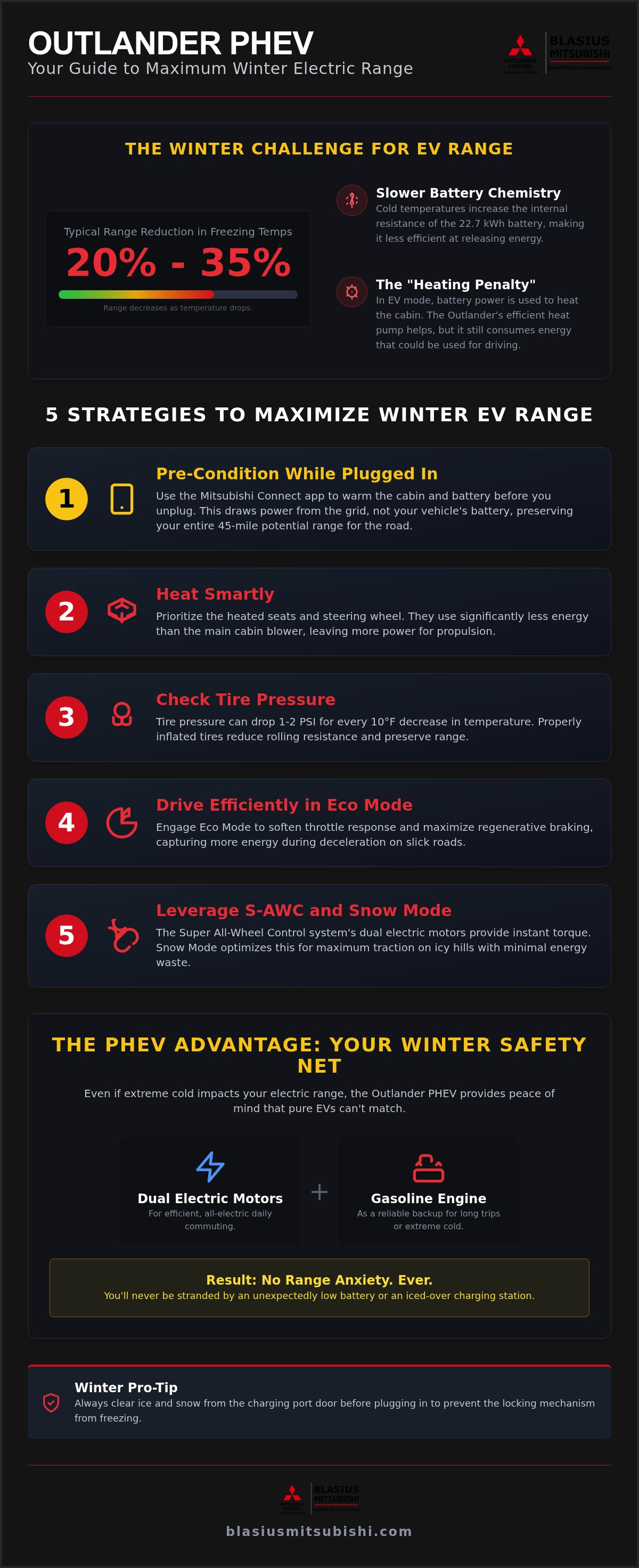
Winter in Connecticut brings more than just icy roads; it brings a shift in how your battery behaves. Inside the 22.7 kWh battery of your vehicle, lithium ions move through a liquid electrolyte to provide power. When temperatures drop below freezing, these chemical reactions slow down. This increased internal resistance means the battery can't release energy as efficiently as it does in July. Consequently, the Mitsubishi Outlander PHEV range winter performance typically sees a decrease of 20% to 35% during our coldest months.
The "Heating Penalty" also plays a significant role in your daily commute. To understand the underlying technology, one might ask What is a Plug-in Hybrid? and how it handles climate control differently than a gas car. While a standard vehicle uses "free" waste heat from the engine to warm the cabin, a PHEV in electric mode must use battery power. The 2026 Outlander PHEV addresses this with an advanced heat pump system. This system works like a refrigerator in reverse, moving heat from the outside air into the cabin. It's far more efficient than older resistive heaters, but it still requires energy that would otherwise move the wheels.
Cabin Comfort vs. Battery Propulsion
Every watt used to clear your windshield or warm your toes is a watt taken away from your driving distance. To protect the battery and ensure your safety, the system may trigger Engine Running Due to Temperature (ERDT). This means the gas engine starts automatically to provide supplemental heat. It's a built-in safety feature that keeps you warm while the hybrid system manages the heavy lifting of winter travel.
5 Strategies to Maximize Your Winter Electric Range
You don't have to settle for reduced mileage just because it's December in Connecticut. By adopting specific winter driving strategies, you can keep your EV mode active for the majority of your local trips. Start by prioritizing the heated seats and steering wheel. These components use significantly less energy than the main cabin blower. Additionally, keep a close watch on your tires. For every 10-degree drop in temperature, tire pressure typically falls by 1 to 2 PSI. This increased rolling resistance can quietly sap your Mitsubishi Outlander PHEV range winter performance before you even leave your neighborhood.
Driving habits also make a difference. Engage Eco Mode to soften throttle response and maximize regenerative braking. On slick Brookfield roads, this helps you capture kinetic energy while maintaining better traction. If you're unsure about your vehicle's cold-weather readiness, you can consult with our Mitsubishi PHEV experts for a seasonal battery health check to ensure everything is operating at peak efficiency.
Mastering the Remote Climate Control Feature
The Mitsubishi Connect app is your most powerful tool for fighting the cold. To use it, simply navigate to the climate settings in the app or the vehicle's infotainment screen and set your scheduled departure time. By warming the cabin while the car is still plugged into a charger, you draw power from the grid rather than the 22.7 kWh battery. This process also pre-conditions the battery cells internally. Warm cells have much lower internal resistance, which directly improves discharge efficiency and helps preserve your Mitsubishi Outlander PHEV range winter totals during those first few critical miles of your commute.
Winter Reliability: S-AWC and the PHEV Safety Advantage
Connecticut's topography demands more than just power; it requires precision. The Super All-Wheel Control (S-AWC) system in the 2026 Outlander PHEV utilizes dual electric motors to provide instantaneous torque to all four wheels. While traditional mechanical systems often experience a slight delay while waiting for gears to engage, these electric motors react in milliseconds. This is a game-changer when you're climbing icy hills in Fairfield County. By selecting Snow Mode, the vehicle optimizes torque distribution to minimize wheel spin, helping you maintain momentum without taxing the battery unnecessarily.
Reliability is where this plug-in hybrid truly outshines pure electric competitors during a New England freeze. Even if extreme cold impacts your Mitsubishi Outlander PHEV range winter efficiency, the gasoline engine serves as a dependable fail-safe. You won't face the fear of being stranded if a charging station is iced over or if the battery level drops faster than expected. To keep the system running smoothly, remember to clear any ice or snow from the charging port door before plugging in, as moisture can freeze the locking mechanism overnight.
Local Expert Support at Blasius Mitsubishi
Since 1929, our family-owned dealership has helped local drivers navigate the seasons. We invite you to visit our Mitsubishi service center in Brookfield, CT for a specialized winter battery health check. Our technicians ensure your hybrid systems are optimized for the cold. We also stock genuine Mitsubishi winter accessories, including heavy-duty all-weather floor mats and specialized wiper blades designed to handle heavy sleet and snow.
Master Your Winter Commute in Connecticut
Driving through a New England winter doesn't have to be a guessing game for your battery. By using smart pre-conditioning and prioritizing efficient heating, you can maximize your Mitsubishi Outlander PHEV range winter performance. Whether you're navigating steep hills in Fairfield County or commuting through slush, the S-AWC system and the backup of a gas engine provide a level of security that pure electric vehicles often lack. At Blasius Mitsubishi, we've been family-owned and operated since 1929. Our expert Mitsubishi certified technicians are here to help with specialized winter maintenance packages designed for local conditions. Ready to see how this plug-in hybrid handles the frost? Explore our 2026 Mitsubishi Outlander PHEV inventory in Brookfield and discover a more reliable way to drive this season. You've got the tools to stay efficient and safe all winter long.
Frequently Asked Questions
How much range does the Mitsubishi Outlander PHEV lose in the winter?
Most drivers see a 20% to 35% reduction in electric mileage when temperatures drop below freezing. This happens because cold air increases battery resistance and cabin heating requires significant energy. While the 2026 model has an official 45-mile range, your Mitsubishi Outlander PHEV range winter performance might dip to around 30 miles on the coldest Connecticut mornings.
Why does the gas engine start in my Outlander PHEV even when the battery is full?
The gas engine often kicks in to generate supplemental heat for the cabin or to protect the battery system from extreme cold. This is known as Engine Running Due to Temperature. It's a normal safety and comfort feature that ensures you have a clear windshield and a warm interior even if you have plenty of electric charge remaining.
Can I charge my Outlander PHEV outside in freezing temperatures?
You can safely charge your vehicle outdoors in freezing weather, as the charging system is designed for all-weather use. However, it's best to clear away any snow or ice from the charging port door before you plug in. If you leave the car plugged in overnight, the battery can use grid power to stay warm, making your morning start much more efficient.
Does using the seat heaters save more range than the cabin heater?
Using seat and steering wheel heaters is significantly more efficient than running the main cabin blower at high temperatures. These localized heaters warm your body directly using very little wattage. By relying on them instead of the full climate control system, you can reduce the overall energy draw on the battery and preserve more of your electric driving distance.


