
Are you tired of watching the numbers climb at the pump every time you fill up in Connecticut? It's frustrating when you need a reliable SUV for New England weather but worry that All-Wheel Control might drain your bank account. We understand that finding the perfect balance between power and efficiency is a top priority for local drivers today.
This guide helps you discover exactly how the 2026 Mitsubishi Outlander Sport mpg ratings stack up across every trim level. You'll learn whether the 148-horsepower 2.0L engine or the more robust 168-horsepower 2.4L engine fits your lifestyle better. We'll also provide practical tips for maintaining high fuel economy on CT roads, ensuring you get the most out of your 15.8-gallon tank regardless of which model you choose.
Key Takeaways
- Compare the specific EPA-estimated ratings for both the 2.0L and 2.4L engines to determine which configuration best suits your driving habits.
- Understand how the Mitsubishi Outlander Sport mpg stays efficient despite the added traction of standard All-Wheel Control.
- Evaluate the performance trade-off between the 148-horsepower base engine and the more powerful 168-horsepower SEL trim.
- Learn how seasonal maintenance and expert service in Brookfield can help you maintain peak fuel efficiency throughout the year.
Breaking Down the 2026 Mitsubishi Outlander Sport MPG Ratings
The 2026 model year builds on the Mitsubishi Outlander Sport history by offering standard All-Wheel Control (AWC) across the entire lineup. Many drivers worry that a permanent grip on all four wheels will tank their fuel economy. However, the Mitsubishi Outlander Sport mpg remains steady because of its smart Continuously Variable Transmission (CVT). This transmission adjusts seamlessly to your speed, ensuring the engine doesn't work harder than it needs to during local commutes around Brookfield.
The 2.0L MIVEC engine is the primary choice for those prioritizing fuel conservation. It produces 148 horsepower, which is plenty for merging onto I-84 or running errands. Because this engine's tuned for efficiency, it provides a consistent experience across almost every trim level in the 2026 catalog. It serves as the efficiency leader for city-heavy commutes where stop-and-go traffic usually drains a tank quickly.
2026 Trim Level Efficiency Comparison
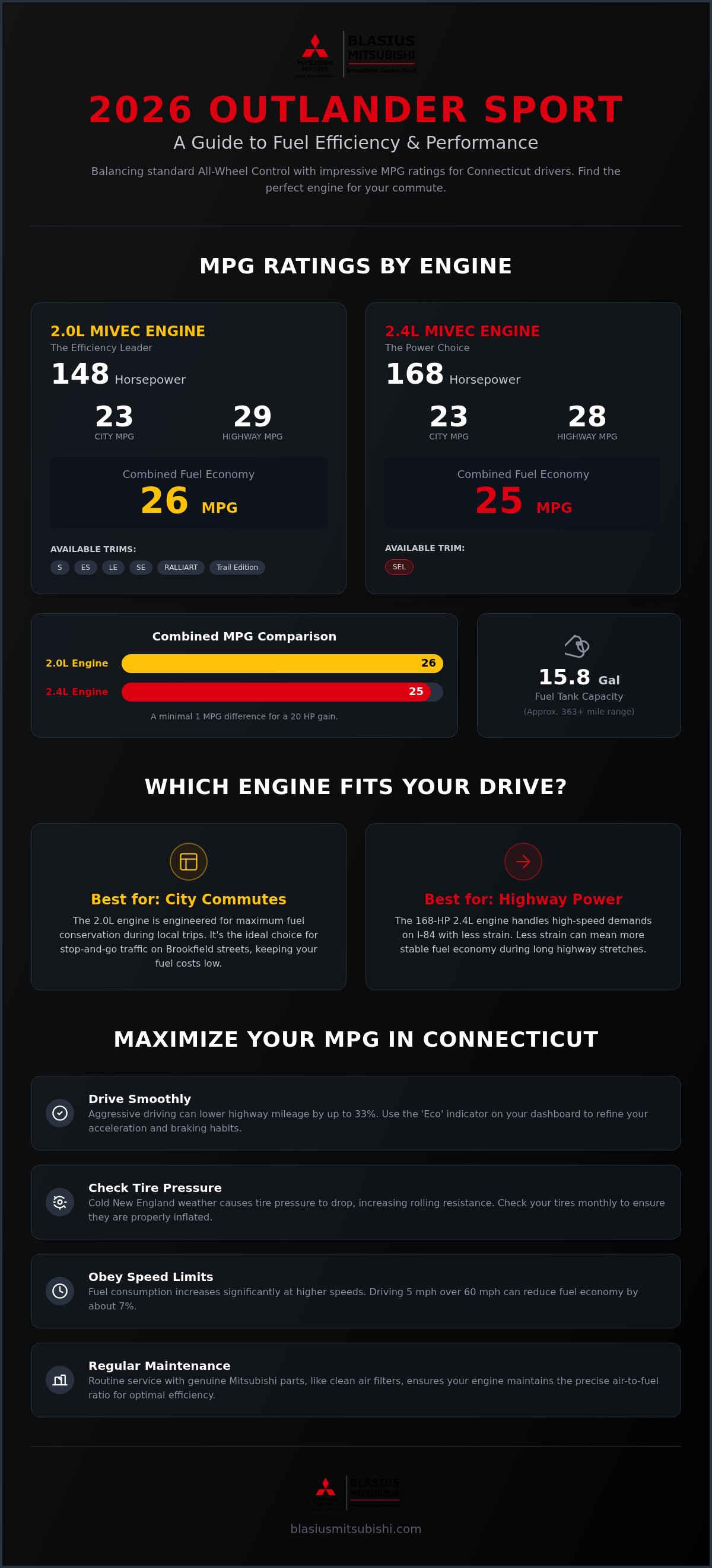
Most of the 2026 lineup, including the S, ES, LE, SE, RALLIART, and Trail Edition, features the 2.0L engine. These models achieve an EPA-estimated 23 mpg in the city and 29 mpg on the highway, resulting in a combined 26 mpg. If you step up to the SEL trim for more power, the 2.4L engine delivers 168 horsepower while only slightly dipping to 28 mpg on the highway. This means the Mitsubishi Outlander Sport mpg stays remarkably consistent even when you opt for the larger engine.
- 2.0L Engine Trims (S, ES, LE, SE, RALLIART, Trail Edition): 23 City / 29 Highway / 26 Combined MPG
- 2.4L Engine Trim (SEL): 23 City / 28 Highway / 25 Combined MPG
- Fuel Tank Capacity: 15.8 Gallons
Choosing between these configurations often comes down to your driving style. The 2.0L is the efficiency leader, while the 2.4L offers extra punch for highway passing with a minimal impact on your monthly fuel budget. With a 15.8-gallon fuel tank, you'll enjoy an approximate range of 363 miles on a full tank in the 2.0L models.
Engine Choice: Efficiency of the 2.0L vs. Power of the 2.4L
Choosing the right engine for your 2026 model depends largely on your daily commute through Fairfield County. The standard 2.0L engine delivers 148 horsepower and is specifically engineered for maximum fuel conservation during local trips. If you spend most of your time on local Brookfield streets, this engine is likely your best bet for keeping costs low. On the other hand, the 2.4L engine in the SEL trim boosts output to 168 horsepower. While the 2.4L might seem thirstier on paper, Official MPG ratings show only a one-mpg difference in combined driving. The MIVEC system uses variable valve timing to balance power and efficiency by adjusting the intake valves based on real-time driving conditions.
When the 2.4L Engine Actually Saves You Fuel
It's a common misconception that a smaller engine always wins on gas. If you frequently commute on the Merritt Parkway or I-84, the 2.4L engine might be the smarter choice. At higher speeds, a smaller engine often operates under a heavier load, meaning it works harder and burns more fuel to maintain pace. The 168-horsepower 2.4L handles these high-speed demands with less strain, which can stabilize your Mitsubishi Outlander Sport mpg during long highway stretches. Additionally, Super All-Wheel Control (S-AWC) is vital for Connecticut winters, though it requires more energy to distribute power when roads get slick. The extra torque from the 2.4L helps manage this power distribution more effectively during heavy snow. You can check our inventory or consult our Mitsubishi service center in Brookfield for more performance insights.
Maximizing Your Outlander Sport MPG in Connecticut
Connecticut's steep hills and sharp temperature swings present unique challenges for fuel economy. While the Car and Driver review highlights the vehicle's steady performance, local drivers can squeeze more miles from every gallon with specific habits. Watch the 'Eco' indicator on your dashboard; it's a real-time coach that helps you refine your acceleration. Aggressive driving can lower your highway mileage by as much as 33%, so steady pressure on the pedal is key when climbing through Fairfield County. Don't forget that Connecticut law prohibits idling, which is the fastest way to get zero miles per gallon while waiting in traffic.
Fluctuating New England weather directly impacts your tires. Cold snaps cause pressure to drop, increasing rolling resistance and dragging down your Mitsubishi Outlander Sport mpg. Checking your tire pressure monthly ensures you aren't fighting against your own wheels. Additionally, adhering to speed limits saves more than just a ticket. Fuel consumption increases by about 7% for every 5 mph you drive over 60 mph on I-84 or the Merritt Parkway.
Local Maintenance Tips for Better Fuel Economy
Routine care at a Mitsubishi service center Brookfield CT is your best defense against rising fuel costs. Our technicians use genuine Mitsubishi air filters to maintain the precise air-to-fuel ratio your MIVEC engine requires. Clogged filters force the engine to work harder, burning extra gas. Scheduling seasonal check-ups at Blasius Mitsubishi also ensures your S-AWC system operates without unnecessary mechanical drag. Keeping the drivetrain lubricated and the fuel system clean helps maintain those factory ratings even as your vehicle ages.
Drive Smarter in Connecticut
Navigating Connecticut roads doesn't have to mean compromising on fuel efficiency. By choosing between the city-friendly 2.0L engine and the highway-ready 2.4L model, you can tailor your Mitsubishi Outlander Sport mpg to your specific driving habits. Staying on top of routine maintenance and monitoring tire pressure are the easiest ways to keep costs low at the pump. Our family-owned business has served the community since 1929, and we're here to help you find the perfect balance of power and savings.
Our expert Mitsubishi-certified technicians will keep your vehicle running at peak performance. We also offer personalized financing for all CT drivers to make your upgrade seamless. Ready to experience this efficiency for yourself? Browse our fuel-efficient 2026 Mitsubishi Outlander Sport inventory in Brookfield! We look forward to helping you hit the road with confidence.
Frequently Asked Questions
Does the Mitsubishi Outlander Sport require premium gas?
No, the 2026 Mitsubishi Outlander Sport runs on regular unleaded gasoline with an 87 octane rating. You don't need to spend extra on premium fuel to maintain performance or reach the estimated Mitsubishi Outlander Sport mpg ratings. Using standard fuel helps keep your daily operating costs lower as you commute through Connecticut. It's designed to be budget-friendly at the pump.
How does the Outlander Sport MPG compare to the standard Outlander?
The Outlander Sport is more compact and designed specifically for nimble city driving, whereas the standard Outlander is a larger three-row SUV. While the standard Outlander offers competitive efficiency for its size, the Sport model is built for maneuverability and urban fuel conservation. Both vehicles utilize MIVEC engine technology to ensure you get the best possible mileage for your specific driving needs.
Does the All-Wheel Drive (AWC) system lower the gas mileage significantly?
No, the standard All-Wheel Control system is integrated to work efficiently with the CVT. While older AWD systems were known for heavy fuel consumption, Mitsubishi's modern drivetrain minimizes mechanical drag. The 2026 model remains competitive because the system only distributes power to the rear wheels when sensors detect a loss of traction, helping maintain your Mitsubishi Outlander Sport mpg.
What is the fuel tank capacity of the 2026 Mitsubishi Outlander Sport?
The 2026 model features a 15.8-gallon fuel tank. Based on the EPA ratings for the 2.0L engine, you can expect an approximate driving range of about 363 miles on a single fill-up. This generous capacity helps reduce the frequency of stops at the gas station during long trips across New England or your daily commute in Brookfield.


