

What if those silver paddle shifters on your steering wheel weren't for racing, but for turning every downhill stretch in Brookfield into a free charging session? Many CT drivers feel a bit intimidated by the humming sounds of a modern plug-in hybrid, which is why having regenerative braking explained Mitsubishi style is the key to driving confidence. It's common to worry that using the paddles might wear out the motor or "break" the car, but you're actually just recycling kinetic energy that would otherwise be wasted.
We've put together this guide to help you stop worrying and start reclaiming miles. You'll learn how to master the 2026 Outlander PHEV's six levels of energy recovery to boost your range during those chilly commutes to Danbury or New Haven. We'll cover everything from the B0 to B5 settings to how this technology significantly slashes your long-term brake maintenance costs by letting the electric motor do the heavy lifting.
Key Takeaways
- Learn how your Outlander PHEV motor acts as a generator to capture kinetic energy that would otherwise be lost during deceleration.
- Discover the specific settings for the six B-mode levels in this regenerative braking explained Mitsubishi breakdown to achieve a smooth one-pedal driving experience.
- Find out how to use Connecticut's hilly terrain to your advantage to extend your EV range and preserve battery health during cold winter months.
- Understand the maintenance benefits of using regen, which can help your friction brake pads last up to 100,000 miles by reducing physical wear and tear.
The Science of Regen: How Your Mitsubishi Recycles Energy
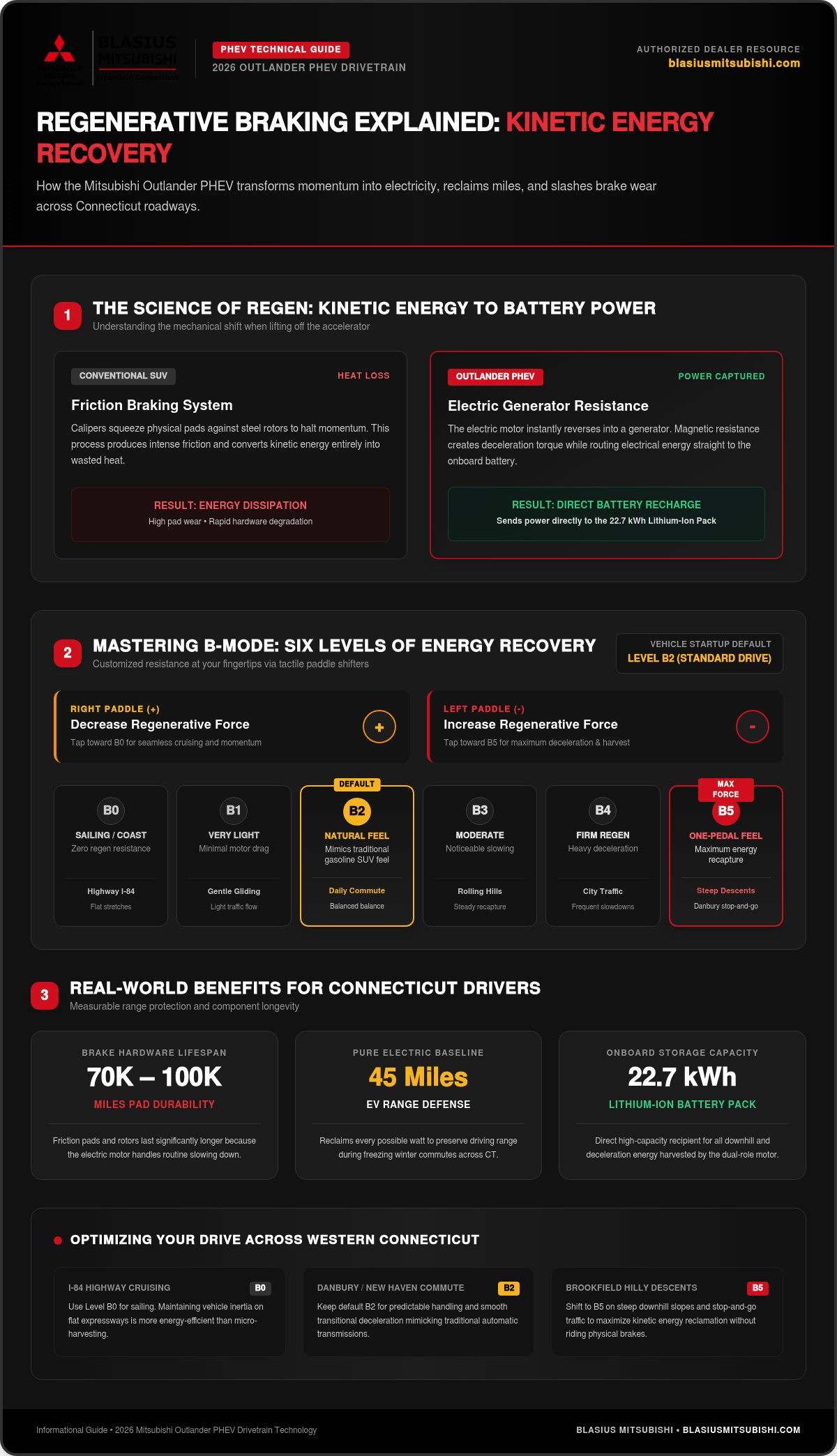
Understanding the physics behind your vehicle is the first step to maximizing its potential. When you lift your foot off the accelerator in a Mitsubishi Outlander PHEV, the electric motor reverses its function. Instead of consuming power to turn the wheels, it becomes a generator. This foundational regenerative braking technology allows your vehicle to capture kinetic energy that traditional SUVs simply lose to the environment as heat. By having regenerative braking explained Mitsubishi owners can see how this process sends electricity straight back into the 22.7 kWh lithium-ion battery pack instead of wasting it.
To see this system in action and learn how to cycle through the various force levels, watch this technical breakdown:
Traditional friction brakes rely on calipers squeezing pads against rotors, creating friction that stops the car but produces immense heat. In contrast, your Mitsubishi uses the magnetic resistance of the electric generator to slow you down. It's a much cleaner, more efficient way to manage momentum. This is especially useful on the rolling hills of Connecticut, where gravity can be your best friend for recharging on the fly.
Kinetic Energy to Battery Power: The Electric Motor Dual Role
The resistance you feel when the motor switches to generator mode is known as regenerative torque. This force does most of the heavy lifting during routine deceleration, which means your physical brake pads and rotors face significantly less stress. While your friction brakes remain fully active for emergency stops and low-speed parking maneuvers, they won't wear down nearly as fast as they would on a gas-only SUV. You get the safety of a traditional system combined with the incredible longevity of a modern hybrid drivetrain.
Driving with Intent: Mastering Mitsubishi B-Mode and Paddle Shifters
Mitsubishi provides a tactile way to manage your energy through steering wheel-mounted paddle shifters. Unlike many competitors that bury these settings in a digital screen, your Outlander PHEV lets you adjust resistance on the fly. This creates a "One-Pedal" driving sensation where lifting off the accelerator provides significant slowing force, capturing energy that would otherwise be lost. It's an engaging way to drive, making regenerative braking explained Mitsubishi style easy to master for any CT owner.
To start using this system effectively, follow these simple steps:
- Shift to Drive (D): The vehicle automatically defaults to level B2 when you start your journey.
- Use the Left Paddle (-): Pull this paddle to increase the regenerative force up to level B5.
- Use the Right Paddle (+): Pull this paddle to decrease the force down to level B0.
Customizing Your Braking Force: Understanding B0 through B5
The six distinct levels allow you to tailor the car's behavior to your specific route. Level B0 is ideal for "sailing" or coasting on flat stretches of I-84, where maintaining momentum is more efficient than capturing small amounts of power. At the other end, B5 provides maximum deceleration. This is perfect for steep descents or navigating heavy stop-and-go traffic in Danbury. Most drivers find the default B2 setting offers a natural balance that mimics the feel of a traditional gasoline vehicle.
By using these paddles, you aren't just extending your range; you're protecting your hardware. According to this U.S. Department of Energy overview of EV brake wear, these systems significantly extend the life of your pads and rotors. If you want to feel the difference for yourself, you can visit our Brookfield showroom for a hands-on demonstration of B-mode driving.
Real-World Benefits for Connecticut Drivers: Range and Maintenance
Connecticut winters are notoriously tough on EV batteries. When temperatures drop, having regenerative braking explained Mitsubishi style helps you combat range anxiety by capturing every possible watt of energy. This system is crucial during those freezing commutes from Brookfield to coastal areas, as it helps maintain your 45-mile pure electric range. Beyond the battery, the maintenance perks are substantial. Since the electric motor manages most of your slowing, friction pads on an Outlander PHEV often last between 70,000 and 100,000 miles. This Kelley Blue Book guide on regenerative brakes notes that these systems drastically reduce the mechanical load on your vehicle's stopping hardware.
Safety is another major factor for local drivers. On slippery Brookfield roads during light snow, regenerative braking provides a more controlled deceleration than traditional friction brakes alone. It reduces the chance of wheel lock-up by using the motor's internal resistance to slow the vehicle down smoothly. This gives you a more confident grip when navigating the winding backroads of Fairfield County.
Maximizing PHEV Performance in Fairfield County Variable Terrain
The hilly terrain between Waterbury and Danbury offers the perfect playground for energy recovery. We recommend using B4 or B5 on long downhill grades to effectively "refuel" your 22.7 kWh battery for free. Experimenting with different levels on your daily commute to New Haven will help you find your efficiency sweet spot. Keep in mind that while regen saves your pads, a regular Mitsubishi brake service at Blasius is still vital. Connecticut road salt can cause corrosion on underused rotors, so our expert technicians ensure your safety remains the top priority.
Take Control of Your Efficiency in Brookfield
Mastering the six levels of energy recovery transforms your daily commute into an active way to extend battery life. By using the paddle shifters to navigate Connecticut's varied hills, you're not just saving fuel; you're significantly reducing the wear on your physical brakes. We hope having regenerative braking explained Mitsubishi style gives you the confidence to toggle through B0 to B5 on your next trip. Our family-owned dealership has served local drivers since 1929, and our expert technicians are specifically trained in advanced PHEV powertrain systems to keep your vehicle in peak condition. Ready to feel the difference for yourself? You can experience the Outlander PHEV’s regenerative braking for yourself—schedule a test drive at Blasius Mitsubishi today! We look forward to helping you unlock your vehicle's full potential.
Frequently Asked Questions
Does regenerative braking charge my battery to 100%?
Regenerative braking won't typically charge your 22.7 kWh battery back to 100% during a standard commute. It's designed to supplement your range by capturing energy during deceleration. Drivers navigating the steep hills around Waterbury or Pougkeepsie will notice the battery percentage tick upward, but you'll still need to plug in for a complete charge before your next long trip.
Will my brake lights come on when I use the paddle shifters to slow down?
Yes, your vehicle is designed to alert other drivers when you slow down significantly. The Outlander PHEV automatically illuminates the rear brake lights during deceleration at levels B4 and B5. This is a critical safety feature for navigating busy intersections in Danbury, ensuring that motorists behind you are aware of your change in speed even without a pedal press.
Can I use regenerative braking if my battery is already full?
If your battery is already at a 100% state of charge, the system will automatically throttle the regenerative force. There's simply no room for the captured energy to go. In this regenerative braking explained Mitsubishi scenario, the vehicle might cycle the engine to provide compression drag, which helps control your speed on long descents through Brookfield without overcharging the pack.
Is regenerative braking bad for the electric motor or transmission?
Not at all. Regenerative braking is an engineered function that actually protects your vehicle's hardware by reducing heat and friction on the pads and rotors. It doesn't strain the electric motor or transmission. For those making the daily trek to New Haven, it's a smart way to maintain your vehicle while enjoying a smoother, more controlled driving experience every day.


