

An unpaid auto loan never blocks a vehicle upgrade; it simply adjusts the transaction balance. When trading in a car with a loan CT drivers often assume they must clear their balance with upfront cash or manage complex bank paperwork alone. You don't. Dealerships routinely coordinate directly with your lender to settle the outstanding lien, whether you hold positive equity or owe more than the car is worth.
It is natural to feel uneasy about how lien transfers, rolling balances, and title handoffs actually work behind the scenes. This guide explains how to calculate your vehicle's equity, secure an official 10-day payoff statement, and take full advantage of Connecticut's sales tax credit to save significantly on your replacement purchase. Here is how to navigate the trade-in process and step into your next ride with total confidence.
Key Takeaways
- When trading in a car with a loan CT dealerships handle the lender communication directly, requiring just an official 10-day payoff statement to settle the existing lien.
- Discover how to calculate your net equity by comparing your loan payoff quote against professional vehicle trade appraisal values.
- Connecticut law applies motor vehicle sales tax only to the net difference between your trade-in credit and the replacement vehicle's price.
- Learn practical options for managing negative equity smoothly, including rolling an outstanding balance into your next contract or offsetting it with cash down.
How Trading In a Car with a Loan Works in CT
Handing over the keys to a financed vehicle is a routine retail transaction. When trading in a car with a loan CT drivers don't have to clear their outstanding balance before stepping onto the lot. Instead, the acquiring dealer assesses the vehicle's market value, contacts your lienholder, and remits payment directly to settle the account on your behalf.
Understanding the basics of how car loans work simplifies this exchange. Because your vehicle serves as collateral, the lending institution retains an active legal claim on the title until you satisfy the debt. The dealer coordinates with your bank to verify your exact payoff figure, deducts that amount from your trade allowance, and forwards a payoff check to release the title.
The Connecticut Lien Payoff and Title Transfer Process
Before heading to a dealership, gather key details to ensure the transaction runs smoothly:
- 10-Day Payoff Letter: Contact your lender to request a written payoff statement that includes daily per diem interest.
- Account Information: Have your active loan account number and customer service payoff contact number ready.
- Current Vehicle Registration: Bring your current Connecticut registration certificate matching your driver's license.
Licensed Connecticut dealerships manage state Department of Motor Vehicles paperwork electronically. Once your previous lender receives the payoff funds and releases the electronic lien, the dealer processes the title transfer directly through the state system. This turnkey process eliminates the need for you to visit the DMV in person, making trading in a car with a loan CT a straightforward, single-visit experience.
Calculating Equity and Connecticut Sales Tax Savings
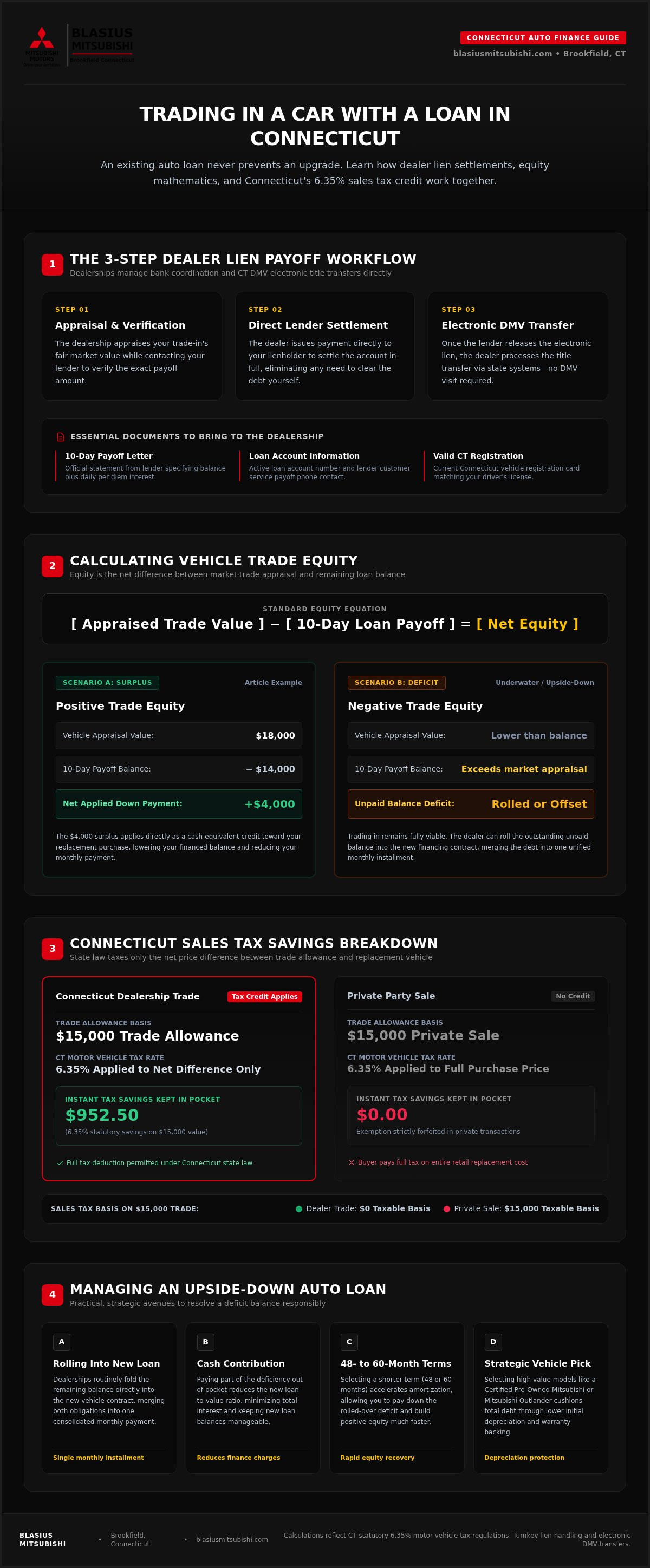
Determining your trade balance begins with straightforward math: subtract your official 10-day loan payoff from the vehicle's appraised trade value. If the dealer offers $18,000 for your car and your lender requires $14,000 to close the note, you hold $4,000 in positive equity. That surplus applies instantly as a cash-equivalent down payment toward your next vehicle purchase, lowering your financed balance and reducing your monthly obligation.
Beyond vehicle equity, trading in a car with a loan CT provides a major statutory financial benefit: the Connecticut trade-in sales tax credit.
Navigating Connecticut Sales Tax Credits on Financed Trades
Under Connecticut state tax law, motor vehicle sales tax applies only to the net difference between your trade allowance and the purchase price of your replacement vehicle. At the state's standard 6.35% motor vehicle sales tax rate, a $15,000 trade allowance reduces your taxable basis by that exact figure, instantly keeping $952.50 in your pocket.
Private party sales don't qualify for this exemption. When you sell to an individual, you forfeit this trade credit entirely and must pay sales tax on the full retail price of your replacement vehicle. Commuters upgrading to an efficient model like the Mitsubishi Outlander for Sale in Connecticut save substantial cash by trading in directly. You can easily estimate your net figures and trade value with Blasius Mitsubishi before finalizing your purchase.
Trading In with Negative Equity or an Underwater Loan
Owing more on your vehicle than its current appraisal value means you have negative equity, commonly known as being upside-down. Even in this situation, trading in a car with a loan CT remains completely viable. Dealerships routinely roll that unpaid deficit directly into the financing contract of your replacement vehicle, combining the remaining obligation into one unified monthly installment.
Carrying debt into a new loan raises your loan-to-value ratio, making strategic vehicle selection vital. Offsetting the difference with a modest cash down payment minimizes total finance charges. Another practical tactic involves selecting a value-packed vehicle, such as a Certified Pre-Owned Mitsubishi in CT, which cushions total debt through lower initial depreciation and factory warranty backing.
Practical Solutions for Managing an Upside-Down Auto Loan
Deciding how to tackle an underwater balance comes down to cash flow and financial goals. You can compare several practical approaches:
- Cash contribution: Paying part of the deficiency out of pocket keeps your new loan balance manageable.
- Shorter loan terms: Choosing a 48- or 60-month term helps you pay down the rolled-over balance and establish positive equity much faster.
Working directly with finance specialists at a reliable Mitsubishi dealer in Brookfield, CT allows you to evaluate lender programs, restructure your debt responsibly, and drive away in a safe, updated SUV without unnecessary stress.
Take the Next Step Toward Your Vehicle Upgrade
Trading in a car with a loan CT doesn't have to be an intimidating financial hurdle. Securing an official 10-day payoff statement gives you complete clarity over your equity, while Connecticut's statutory trade credit substantially reduces your replacement vehicle's sales tax. Whether applying positive equity toward a down payment or rolling over an existing balance, you can easily shift into a dependable new ride without managing lienholder paperwork alone.
Backed by the family-owned Blasius Auto Group serving Connecticut drivers since 1929, our Brookfield finance team coordinates directly with your lender to clear existing balances seamlessly. Explore our extensive selection of new Outlander SUVs and multi-point inspected Certified Pre-Owned models. Value your trade and explore personalized financing at Blasius Mitsubishi to upgrade your daily commute with complete confidence.
Frequently Asked Questions
Can I trade in a car if I still owe money on my loan in Connecticut?
Yes, you can trade in a financed vehicle at any licensed dealership in Connecticut. When trading in a car with a loan CT dealerships take care of contacting your current lienholder directly to satisfy the balance. You don't have to wait until you own the vehicle outright or pay off the debt beforehand. The dealer simply deducts the lien payoff from your trade appraisal value.
What is a 10-day payoff quote and how do I get one from my lender?
A 10-day payoff quote is an official statement showing the exact dollar amount required to satisfy your auto loan completely, including daily per diem interest. You can request this figure through your lender's online portal or over the phone. The 10-day window provides the purchasing dealership sufficient time to mail or wire funds before additional interest accrues on the account.
Does trading in a financed vehicle lower my sales tax in CT?
Yes, trading in a financed vehicle provides the exact same Connecticut sales tax reduction as trading in a car owned free and clear. State regulations deduct the gross appraisal value of your trade-in directly from the new vehicle's purchase price before calculating sales tax. This means your tax savings depend entirely on the vehicle's market value, not your remaining loan balance.
What happens if my car is worth less than what I owe on my loan?
If your vehicle is worth less than your remaining balance, you have negative equity. When trading in a car with a loan CT dealerships let you roll that difference directly into the financing for your replacement vehicle. Alternatively, you can pay down the deficit with cash or pick inventory with stronger rebates to keep your new monthly payments within your target budget.


